Your Candle Burning Guide

Nothing compares to the ambiance of a burning candle. Candles provide delightful lighting, soothe the atmosphere, and fill your space with amazing fragrances. So, you've chosen your favorite scented candle and are eager to light it. What comes next? Should you just ignite it and walk away? Not quite.
While candles are a fantastic addition to any home, they also involve an open flame that requires attention. Just like with your stove, microwave, or hair dryer, you'll need to develop a few simple habits to enhance the life and safety of your candle. Don't worry, candle care isn't overly complicated.
Habit #1 - Wick Trimming
One of the most crucial aspects of candle care, perhaps even the most critical, is trimming the wick. The length of the wick directly influences the size of the flame. If the flame is too large, your candle will burn too quickly. Moreover, a flame that is too big can pose a burn or fire hazard. Trim your candle wick to about 1/4 inch using scissors, nail clippers, or a wick trimmer.
Habit #2 - Maintain the wick at 1/4 inch throughout its life
Don’t just trim the wick when you first get your candle. As the candle burns down deeper into the jar, it can get hotter. To keep the temperature in check, maintain the wick at approximately 1/4 inch. I personally trim the wick every time I light any candle.
For Bridge the Gap Shop's candles, you can let the wick be a little longer when you first receive it, but as it burns deeper into the jar, ensure you keep that wick length at 1/4 inch.
Habit #3 - Burn until you achieve a nearly full melt pool
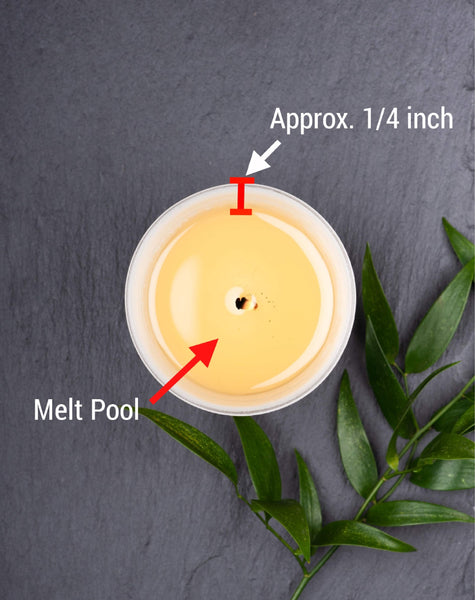
A melt pool is that thin layer of melted wax that forms around the candle flame. It's essential to burn your candle long enough for almost all the wax to melt in this pool. If you extinguish the candle too early, you might experience tunneling, where the flame burns down a narrow tunnel, leaving unmelted wax around the jar's rim. For Bridge the Gap Shop's candles, aim for a nearly full melt pool after burning for 2 to 3 hours.

I say "nearly full" because a small amount of unmelted wax (about 1/4 inch) around the rim is normal and will melt down during future burns.
Habit #4 - Limit burn time to 4 hours
The longer a candle burns, the longer the wick becomes, and more carbon builds up on it. Eventually, you’ll need to trim off that extra length and carbon. After four hours, extinguish the candle. Once it has cooled, trim the wick back to 1/4 inch.

Habit #5 - Burn in appropriately sized room
This step often goes unmentioned by candle companies, yet it deserves more attention. A melt pool can only release a limited amount of fragrance. Using a tiny votive candle in a large family room with vaulted ceilings won’t yield much scent. Generally, smaller candles are best suited for smaller rooms, while larger candles can fill larger spaces.
For our popular 9 oz candles, burn them in small to medium-sized rooms like bathrooms or bedrooms. In larger areas, place one 9 oz candle every ten feet.
Habit #6 - Keep candles away from drafts and air currents
Drafts can significantly impact how a candle burns. If your candle is located near an open window or a cold draft, tunneling may occur. Position your candle away from drafts and strong air currents to guarantee a smooth, clean burn.

Habit #7 - Avoid using the wooden lid to extinguish the flame
The wooden lids that accompany the candles are made of wood, which can burn. Placing the wooden lid over the flame to snuff it out will scorch the underside of the lid. Instead, blow out the candle or use a candle snuffer or wax dipper to extinguish the flame.
Candle Safety Tips
Follow these general safety tips for your best candle burning experience.
- Keep candles out of reach of children and pets. Keep those kiddies safe and burn where they cannot reach.
- Never leave a burning candle unattended. Burn the candle within eyesight and blow it out before you leave the house.
- Blow out the candle after 4 hours. Blow out the candle before you go to bed too.
- Do not burn a candle on or near a hot surface or around combustible materials. Keep away from paper, curtains, fabric and do not burn the candle on flammable materials such as wood. Place a fire resistant metal or ceramic layer between the candle and your table.